

Published 17 October 2026; updated 20 October 2026
Stonehenge may be one of the world’s best-studied and visited prehistoric monuments, but every October Google searches reveal that Britain is still fascinated by its stranger side — from Druids and ley lines to aliens, ghosts and even giants.
New analysis of UK Google search demand by StonehengeVisit.co.uk has found that searches for “Halloween Stonehenge” reach seven times their average monthly level during October.
But Halloween is only part of the fascination. Across a consistent set of measurable searches linking Stonehenge with mysteries, Druids, aliens, UFOs, ley lines, ghosts, sacrifice, legends and other unusual theories, the monument generated combined estimated UK monthly search demand of around 1,190 searches.
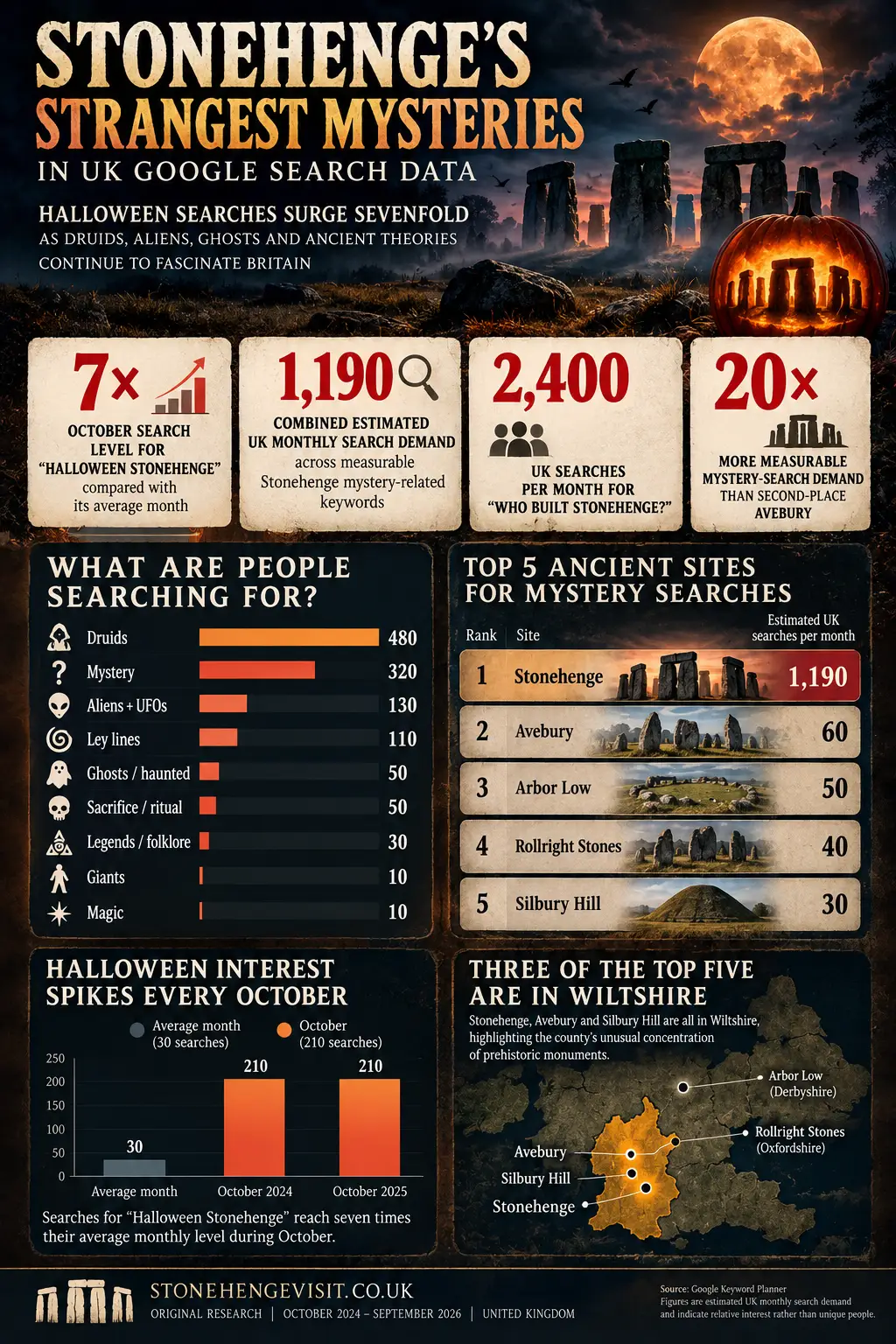
Stonehenge’s strangest mysteries in UK Google search data. Journalists and publishers may reproduce this infographic with attribution to StonehengeVisit.co.uk. Click the image for the full-resolution version.
Halloween interest in Stonehenge surges every October
The clearest seasonal pattern in the research is the search “Halloween Stonehenge”.
Across the two-year Google Keyword Planner dataset, the term averages around 30 UK searches per month.
Yet in October 2024 it reached 210 searches. Exactly the same peak was recorded again in October 2025.
In other words, October search demand was seven times the average monthly level — a 600% increase compared with the average month.
The Halloween interest is particularly timely in 2026. English Heritage is running Halloween Half-Term at Stonehenge from 17 October to 1 November, with seasonal family activities taking place at the monument.
Aliens, ghosts and Druids: what are people searching for?
Stonehenge has attracted myths and competing interpretations for centuries, and modern Google searches show that many of those ideas remain firmly embedded in the public imagination.
StonehengeVisit.co.uk tested a consistent group of mystery-related searches including Druids, aliens, UFOs, ghosts, ley lines, sacrifice, legends, giants and magic.
Of the themes with measurable UK search volume, Druids were by far the biggest fascination.
| Stonehenge mystery theme | Estimated UK searches per month |
|---|---|
| Druids | 480 |
| Mystery | 320 |
| Aliens + UFOs | 130 |
| Ley lines | 110 |
| Ghosts / haunted / paranormal | 50 |
| Sacrifice / ritual | 50 |
| Legends / folklore | 30 |
| Giants | 10 |
| Magic | 10 |
Combined, the measurable keyword themes represent around 1,190 searches of estimated UK monthly search demand.
At the same average monthly level, that is equivalent to more than 14,000 searches across a year.
A note on the numbers: Google Keyword Planner rounds many lower-volume estimates and does not report meaningful volume for every search tested. Where reversed or closely related keyword variants represented the same underlying search theme, the analysis uses the strongest reported estimate rather than adding near-duplicate variants together. The figures should therefore be read as an indication of relative search demand, rather than a count of unique people.
2,400 searches every month still ask: who built Stonehenge?
One of the biggest questions in the entire dataset is not paranormal at all.
The search “who built Stonehenge?” receives an estimated 2,400 UK searches every month.
Yet surrounding that perfectly reasonable archaeological question are some much stranger alternatives.
| What people search | Estimated UK searches per month |
|---|---|
| Is Stonehenge haunted? | 30 |
| Did aliens build Stonehenge? | 20 |
| Did Druids build Stonehenge? | 10 |
| Did giants build Stonehenge? | 10 |
| Was Stonehenge built by aliens? | 10 |
Stonehenge dominates Britain’s ancient mystery searches
The study did not only look at Stonehenge.
The same mystery-related keyword themes were tested against 27 ancient sites and prehistoric landmarks around Britain.
Most individual combinations were too small for Google Keyword Planner to return measurable volume. Among those where measurable demand was recorded, Stonehenge was the overwhelming leader.
| Rank | Ancient site | Measurable mystery-related search demand / month |
|---|---|---|
| 1 | Stonehenge | 1,190 |
| 2 | Avebury | 60 |
| 3 | Arbor Low | 50 |
| 4 | Rollright Stones | 40 |
| 5 | Silbury Hill | 30 |
Using the stricter methodology that avoids adding near-identical keyword variants together, Stonehenge generated approximately 20 times as much measurable mystery-related search demand as second-place Avebury.
Three of the top five are in Wiltshire
There is another striking regional pattern.
Stonehenge, Avebury and Silbury Hill are all in Wiltshire, meaning three of the five ancient sites with the highest measurable mystery-search demand in the research are found within the county.
The result reinforces Wiltshire’s unusual concentration of prehistoric monuments, including the Stonehenge and Avebury World Heritage Site.
Britain’s surprise ancient mystery hotspot may be in Derbyshire
Stonehenge comfortably wins in absolute search volume, but the data produces a much less obvious result when mystery searches are compared with ordinary searches for each site.
Derbyshire’s Arbor Low receives around 50 measurable mystery-related searches per month, compared with approximately 1,900 searches per month for the landmark itself.
That gives it an indicative mystery-search ratio of roughly 2.6%.
Stonehenge, by comparison, receives approximately 301,000 searches per month for the monument itself, meaning its measurable mystery-related search demand represents around 0.4% of its much larger overall search demand.
Because Google Keyword Planner rounds lower search-volume estimates, this ratio should be treated as a directional finding rather than a precise measure of public belief or behaviour.
So what does the archaeology actually tell us?
Search demand tells us what people are curious about. It does not mean the theories themselves are supported by archaeology.
Stonehenge’s long history has attracted changing explanations for centuries, and several of the ideas people still search today have historical roots of their own.
No. The monument was already ancient by the period associated with the historical Druids. English Heritage records that the Druid theory became influential through antiquarians such as John Aubrey and William Stukeley centuries later.
There is no archaeological evidence for extraterrestrial involvement. Stonehenge instead provides evidence of extraordinary prehistoric human organisation, engineering and stoneworking.
This one has genuinely ancient roots in British folklore. A medieval story recorded by Geoffrey of Monmouth connected Stonehenge with a monument known as the “Giant’s Round” and the wizard Merlin.
There is no evidence that human sacrifices took place at Stonehenge. The prehistoric landscape was associated with ritual and ceremony, and the earliest Stonehenge monument also served as a cremation cemetery, but that is very different from evidence of human sacrifice.
English Heritage’s own history of the monument shows how interpretations have changed repeatedly — from medieval tales of Merlin and giants, through later theories involving Romans and Druids, to modern archaeological research.
“What makes Stonehenge extraordinary is that thousands of years of archaeology still have to compete with aliens, ghosts, Druids and giants in the public imagination.”
“The Halloween spike is fun, but the wider search data tells a bigger story. People aren’t only asking what Stonehenge is — they’re still trying to explain what they don’t understand about it.”
Methodology
StonehengeVisit.co.uk analysed UK search-demand estimates from Google Keyword Planner covering the period from October 2024 to September 2026.
The analysis tested a consistent selection of mystery-related modifiers against 27 ancient sites and monuments.
These included: haunted, ghost, ghosts, alien, aliens, UFO, giant, giants, Druid, Druids, human sacrifice, sacrifice, ritual, ley line, ley lines, curse, cursed, mystery, mysteries, supernatural, paranormal, legend, legends, folklore and magic.
The Stonehenge mystery total represents the combined measurable average monthly search demand returned across the consistent landmark-and-theme keyword set.
To avoid artificially inflating results where Google reported search volume for reversed or closely related versions of essentially the same query, the ranking uses the highest reported estimate for each landmark and underlying mystery theme rather than adding near-duplicate word-order variants together.
For example, where both a “landmark + mystery” and “mystery + landmark” variant produced measurable search volume for the same underlying topic, they were treated as one theme for ranking purposes.
Separate question searches such as “who built Stonehenge?”, “did aliens build Stonehenge?” and Halloween-specific keywords were analysed separately and were not added to the 1,190 mystery-theme figure.
Google Keyword Planner rounds many low-volume estimates and does not report meaningful search volume for every term. An unreported term should therefore not be interpreted as evidence that nobody searches for it.
Search figures indicate relative and directional search demand rather than unique searchers.
Search settings were: United Kingdom, English, and Google Search.
Want to see Stonehenge for yourself?
If the mysteries have made you want to see the stones first-hand, explore our independent guide to Stonehenge tours , including direct trips from London and special-access experiences.
You can also compare current Stonehenge ticket prices and entry options before planning your visit.
For journalists & publishers
Journalists and publishers are welcome to reference these findings with attribution to StonehengeVisit.co.uk.
The accompanying infographic may be reproduced with attribution. The underlying keyword research, methodology notes, regional findings and additional comment from Christopher Clayton are available on request.