

Published 11 October 2026; updated 11 October 2026
There is an old stereotype that women organise the trip while men leave things until the last minute. New Stonehenge booking data suggests there may be something in it — but the bigger surprise is how many visitors, especially British families, leave the attraction booking until just days before they go.
StonehengeVisit.co.uk analysed recent non-cancelled bookings across its Stonehenge tours to see who books, how far ahead they book, and whether behaviour changes by country and party type.
The headline finding is simple: women booked a median five days before travel, compared with two days for men. But the most eye-catching country story is that British customers were the most last-minute of the major markets, while family trips were often left until the final few days.
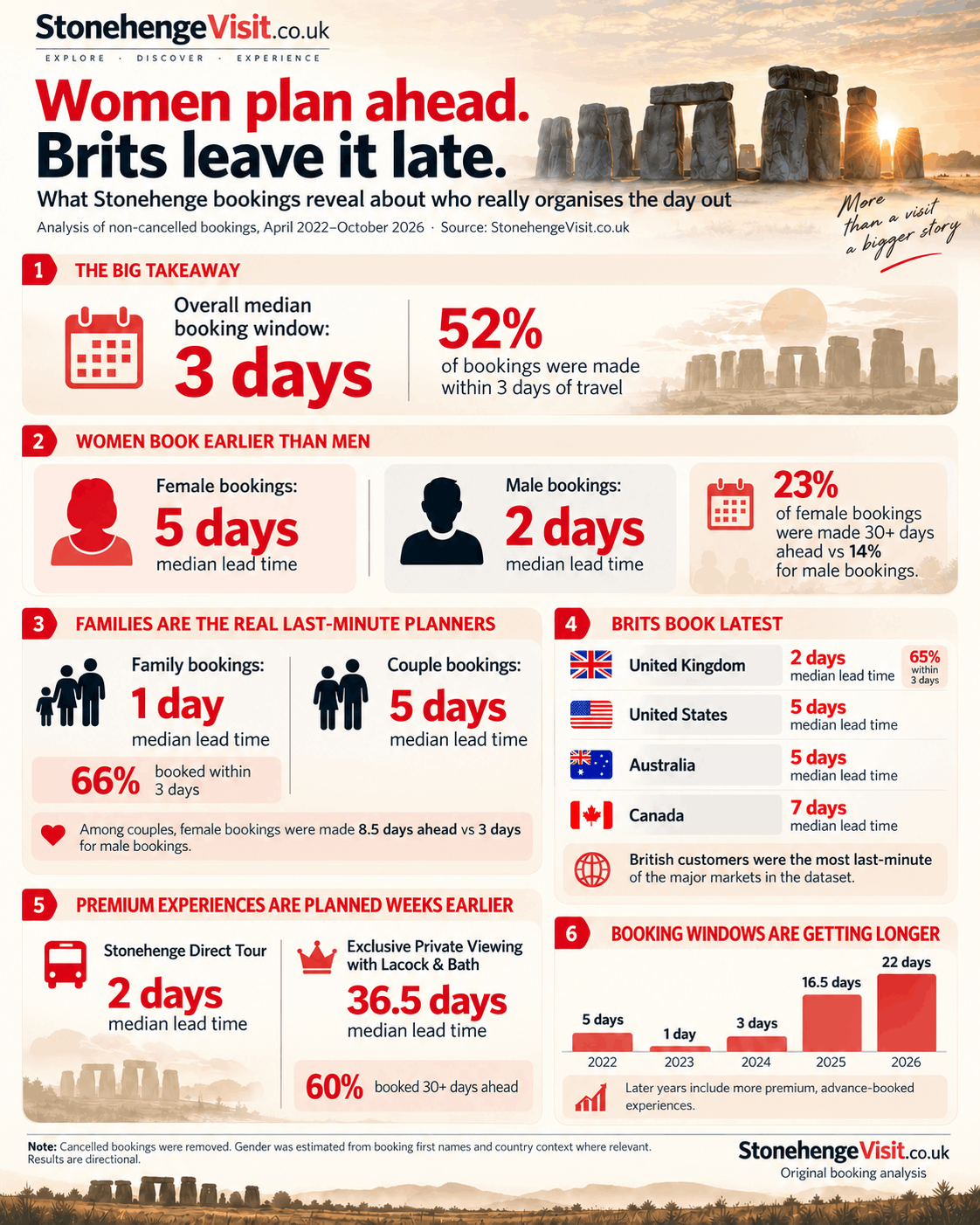
Stonehenge booking trends, 2022–2026. Journalists and publishers may reproduce this infographic with attribution to StonehengeVisit.co.uk. Click the image for the full-size version.
So are women really more organised than men?
On this dataset, when it comes to booking early, the answer appears to be yes — although not quite in the way the stereotype suggests.
Women were only slightly more likely to be the named lead booker overall. After estimating likely gender from booking first names and leaving a small number of ambiguous names unclassified, 51% of classified bookings were made by women and 49% by men.
The much bigger difference was when the booking happened.
Bookings made by women were placed a median of five days before travel. For men, the median was just two days.
Female bookings were also more likely to be genuinely long-range plans: 23% were made at least 30 days ahead, compared with 14% for male bookings.
So the Stonehenge data does not really show women doing dramatically more of the organising. It suggests they are simply more likely to get it organised earlier.
Couples show the clearest planning gap
The sharpest battle-of-the-sexes split appeared among couples.
Among couple bookings, those made by women were placed a median 8.5 days before travel. Male couple bookings were made a median of just 3 days ahead.
Family bookings behaved differently. Both male and female family bookings tended to be extremely last minute, with a median lead time of just 1 day regardless of who booked.
| Party type | Median lead time | Booked within 3 days | Female booking share* |
|---|---|---|---|
| Family | 1 day | 66% | 54% |
| Couple | 5 days | 46% | 51% |
| Solo | 1 day | 64% | 46% |
| Adult group | 28 days | 30% | 59% |
*Female booking share is based on the likely gender of the lead booking name, estimated from the first name. It is not a measure of gender identity.
Brits leave Stonehenge latest
The country-level pattern is especially interesting.
Among the four largest customer markets in the dataset, UK customers booked latest, with a median lead time of just 2 days. American and Australian customers both booked a median 5 days ahead, while Canadian customers booked furthest ahead at 7 days.
| Customer country | Median lead time | Booked within 3 days | Female booking share* |
|---|---|---|---|
| United Kingdom | 2 days | 65% | 54% |
| United States | 5 days | 47% | 54% |
| Australia | 5 days | 50% | 67% |
| Canada | 7 days | 40% | 36% |
That means almost two-thirds of British customers booked within three days of visiting, compared with fewer than half of Americans.
There is a simple interpretation here: long-haul visitors may organise the Britain trip well in advance, but many decide on the exact Stonehenge experience only shortly before travel.
Families are last-minute; private access is planned weeks ahead
The biggest difference in the entire dataset is not gender or nationality. It is product type.
The standard Stonehenge Direct Tour had a median booking lead time of only 2 days.
By contrast, the Stonehenge Exclusive Private Viewing with Lacock & Bath had a median lead time of 36.5 days, with 60% of bookings made at least a month ahead.
This helps explain why later years in the dataset appear more planned: the product mix has shifted toward more advance-booked premium experiences.
Has this changed over time?
Yes — at least directionally. Booking windows appear to be getting longer.
| Booking year | Median days before travel |
|---|---|
| 2022 | 5 |
| 2023 | 1 |
| 2024 | 3 |
| 2025 | 16.5 |
| 2026 to October | 22 |
That is a big shift. But it should be treated carefully because the later years include more long-lead special-access and private-viewing products, and the sample sizes are smaller.
The wider travel context: Britain may be booked months ahead, Stonehenge often isn’t
The Stonehenge pattern looks strikingly late when compared with wider UK travel behaviour.
VisitBritain has reported that the most common booking window for inbound trips to Britain is 1–2 months before travel, while another large share are booked even earlier. Against that backdrop, Stonehenge’s overall median of 3 days looks extremely short.
That suggests an important distinction: the international trip may be planned first, while the Stonehenge experience gets decided much closer to the visit date.
“There is an obvious stereotype here, and the funny thing is that the data partly backs it up.”
“Women were not dramatically more likely to make the booking, but when their name was on it, the booking tended to happen earlier. The bigger surprise was how many British customers — and especially families — seemed to leave Stonehenge until the final few days.”
Methodology
StonehengeVisit.co.uk analysed booking data covering April 2022 to October 2026.
Cancelled bookings were removed before analysis so that the published findings reflect only non-cancelled bookings.
Booking lead time is the number of days between the booking date and the travel date.
Family bookings were defined as bookings containing at least one child, youth, infant or family ticket. Couple bookings were defined as exactly two passengers with no child, youth, infant or family ticket. Adult groups were bookings of three or more passengers without children.
For readability, the article refers to male and female bookings. These were estimated from the first name on the booking, using common naming conventions and country context where relevant. This is not a measure of gender identity, and a small number of ambiguous names were left unclassified rather than forced into a category.
For journalists & publishers
Journalists and publishers are welcome to reference these findings with attribution to StonehengeVisit.co.uk.
The infographic above may be reproduced with attribution. Aggregate supporting data, methodology notes and comment from Christopher Clayton are available on request.