


Published 25 September 2026; updated 25 September 2026
Ahead of Stonehenge’s 40th anniversary as a UNESCO World Heritage Site this November, StonehengeVisit.co.uk has analysed how Britain’s World Heritage landscape has changed since 1986 — and how strongly heritage still shapes the country’s visitor economy.
Stonehenge, Avebury and Associated Sites was among just seven UK properties inscribed in 1986. Today the United Kingdom has 35 World Heritage properties — five times the number recognised in that first year.
And the designation is far from a historical footnote: four of England’s six most visited paid attractions in VisitEngland’s 2024 survey are within World Heritage properties.
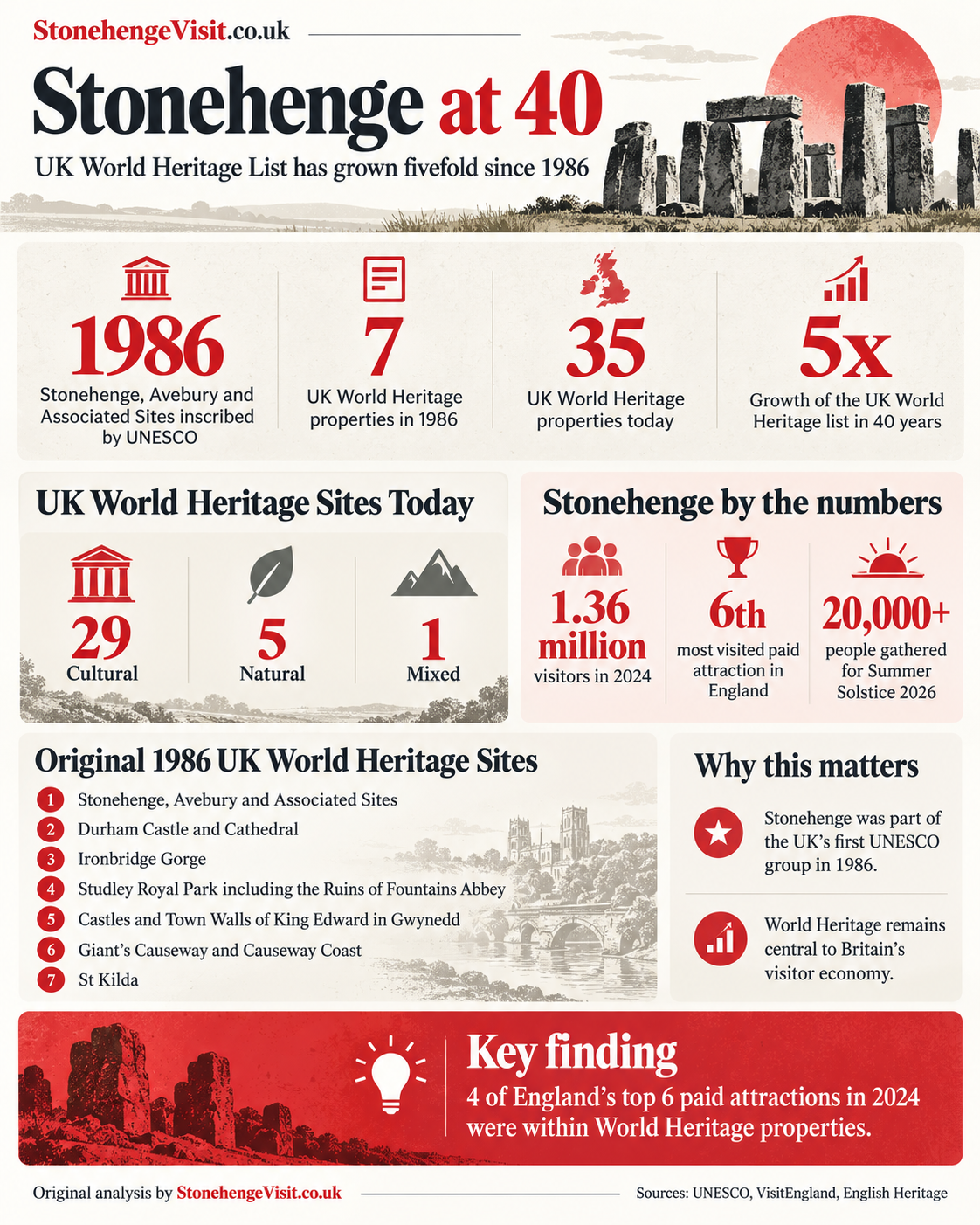
Stonehenge at 40: UK World Heritage by the numbers. Journalists and publishers may reproduce this graphic with attribution to StonehengeVisit.co.uk. Click the image for the full-size version.
The seven places that began the UK’s World Heritage story
Stonehenge was part of an extraordinary first group of UK properties inscribed during the 10th session of the World Heritage Committee in Paris, held from 24–28 November 1986.
| 1986 property | Nation | Current UNESCO category |
|---|---|---|
| Stonehenge, Avebury and Associated Sites | England | Cultural |
| Durham Castle and Cathedral | England | Cultural |
| Ironbridge Gorge | England | Cultural |
| Studley Royal Park including the Ruins of Fountains Abbey | England | Cultural |
| Castles and Town Walls of King Edward in Gwynedd | Wales | Cultural |
| Giant’s Causeway and Causeway Coast | Northern Ireland | Natural |
| St Kilda | Scotland | Mixed |
All seven remain on the World Heritage List today. Together they now represent just one fifth of the UK’s 35 current World Heritage properties.
From seven World Heritage properties to 35
The UK ratified the World Heritage Convention in 1984. Two years later its first seven properties were inscribed. Four decades on, UNESCO lists 35 UK properties: 29 cultural, five natural and one mixed.
The list now stretches from prehistoric landscapes and medieval castles to industrial heritage, scientific sites and globally significant natural landscapes. Later additions include the City of Bath, the Tower of London, Royal Botanic Gardens Kew, the English Lake District, Jodrell Bank Observatory, the Slate Landscape of Northwest Wales and the Flow Country.
Stonehenge’s World Heritage Site is far bigger than the stone circle
For many visitors, “Stonehenge” means the famous ring of stones on Salisbury Plain. The UNESCO property is considerably larger.
Stonehenge, Avebury and Associated Sites covers 5,152.39 hectares across two prehistoric landscapes in Wiltshire.
UNESCO describes Stonehenge as the most architecturally sophisticated prehistoric stone circle in the world, while Avebury is the largest. Together with their associated monuments and landscapes, they preserve evidence of around 2,000 years of monument building and use, from about 3700 to 1600 BC.
The Stonehenge landscape includes the Avenue, the Cursuses, Durrington Walls, Woodhenge and Britain’s densest concentration of burial mounds. At Avebury, the World Heritage landscape includes the Avebury henge and stone circles, Silbury Hill, West Kennet Long Barrow and other major prehistoric monuments.
Stonehenge remains one of England’s most visited paid attractions
World Heritage status may be 40 years old, but public demand for these places remains enormous.
VisitEngland recorded 1,363,252 visitors to Stonehenge in 2024, up 3% from 1,327,423 in 2023. Among attractions participating in the annual survey and publishing their figures, that made Stonehenge the sixth most visited paid attraction in England and the most visited paid attraction in the South West.
| Rank | Paid attraction | 2024 visitors | Within a World Heritage property? |
|---|---|---|---|
| 1 | Tower of London | 2,902,385 | Yes |
| 2 | Royal Botanic Gardens, Kew | 2,273,976 | Yes |
| 3 | Chester Zoo | 1,947,544 | No |
| 4 | Westminster Abbey | 1,717,296 | Yes |
| 5 | St Paul’s Cathedral | 1,493,184 | No |
| 6 | Stonehenge | 1,363,252 | Yes |
That means four of the six highest-ranking paid attractions in England’s 2024 survey were attractions within World Heritage properties.
VisitEngland’s attraction survey is voluntary. The rankings therefore relate to participating attractions that agreed to publish visitor figures, rather than every attraction in England.
A prehistoric site with a very modern global audience
The annual visitor total captures only one part of Stonehenge’s reach.
English Heritage reported that more than 20,000 people gathered at Stonehenge for the 2026 Summer Solstice. Its sunset and sunrise livestreams were watched more than 180,000 times by viewers around the world.
Stonehenge therefore operates simultaneously as a visitor attraction, internationally protected archaeological landscape, research site and living gathering place.
“The 40th anniversary is a chance to look beyond the stone circle itself. Stonehenge was part of the UK’s very first group of World Heritage properties. There were seven in 1986 and there are 35 today — yet the public appetite for these places remains extraordinary.”
“For visitors, World Heritage status can look like a badge on a sign. In reality it protects a much bigger prehistoric landscape and represents an ongoing commitment to safeguarding places whose importance extends far beyond the UK.”
Forty years on
Stonehenge itself is several thousand years old, so four decades can seem almost insignificant.
But November 2026 marks an important milestone in its modern story. When Stonehenge and Avebury joined UNESCO’s list in 1986, they were part of the UK’s first group of seven World Heritage properties.
Today there are 35.
And while the list has changed dramatically, Stonehenge remains one of Britain’s most visited, most recognisable and most internationally significant heritage landscapes.
Methodology
StonehengeVisit.co.uk compared UNESCO’s current list of UK World Heritage properties with the properties inscribed during the World Heritage Committee’s 10th session in Paris in November 1986.
Current UK property counts and categories are taken from UNESCO. Visitor figures are from VisitEngland’s 2024 Annual Survey of Visits to Visitor Attractions, the latest full annual attraction dataset available when this analysis was prepared. Stonehenge Summer Solstice attendance and livestream figures are from English Heritage.
For journalists & publishers
Journalists and publishers are welcome to reference the findings in this research with attribution to StonehengeVisit.co.uk.
The infographic above may also be reproduced with attribution. Source links, supporting calculations and comment from Christopher Clayton are available on request.
View full-size press graphic